
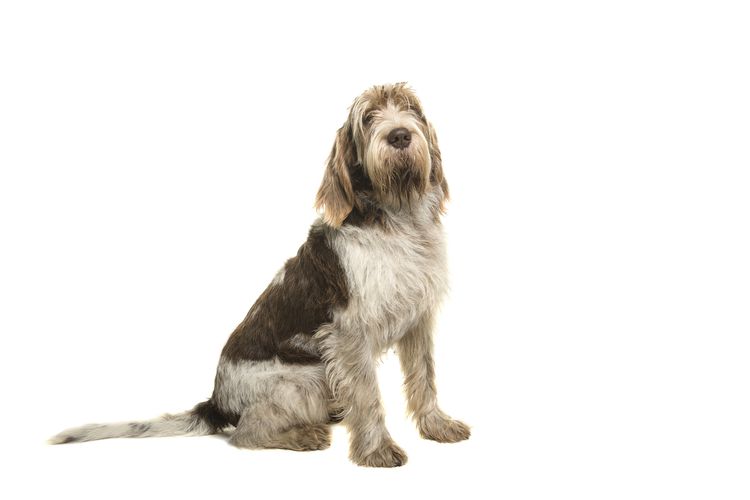
The Spinone Italiano is a large sporting dog breed from Italy with a medium-length, wiry coat that features longer hair forming eyebrows and a beard. Overall, it has a muscular, square build that suits it as an all-terrain hunting dog with excellent endurance. But its sweet, expressive eyes convey that this is also a very companionable breed that adores its family.
Breed Overview
Group: Sporting
Height: 22 to 25 inches (female), 23 to 27 inches (male)
Weight: 60 to 70 pounds (female), 70 to 80 pounds (male)
Coat: Wiry, medium-length
Coat Color: Orange roan, white, white and orange, or brown roan with/without orange and/or brown markings
Life Span: 10 to 12 years
Temperament: Sociable, affectionate, bright
Hypoallergenic: No
Origin: Italy
Characteristics of the Spinone Italiano
The Spinone Italiano generally has a sweet and sociable personality with its family, though a stubborn streak also can be a component of its temperament. It’s not an extremely high-energy dog like many other sporting breeds. But it still needs a fair amount of exercise.
History of the Spinone Italiano
The exact origin of the Spinone Italiano is unknown. But its ancestors likely have been present in Italy for hundreds of years. The breed is possibly a mix of coarse-coated Italian setters with white mastiffs, French griffons, and other dogs.
What resulted was a reliable hunting dog with an excellent nose. It could work in all types of weather and terrain, including water. And its thick, wiry coat served to protect it from the thorny vegetation that’s found throughout Italy’s Piedmont region where the modern Spinone developed.
The breed still remains fairly uncommon around the world. The Spinone Club of America formed in 1987, and the American Kennel Club officially recognized the breed in 2000.
Spinone Italiano Care
This breed enjoys being active with its humans every day. It does have some involved grooming needs to maintain its wiry coat. And it should receive training and socialization from a young age.
Exercise
Plan on at least an hour or two of exercise per day for a Spinone Italiano. These dogs prefer to be active with you, rather than being left to their own devices. Walks, jogging, hiking, and swimming all are great ways to exercise your dog. Plus, dog sports, such as agility and tracking, can provide mental and physical challenges.
Grooming
The Spinone Italiano’s coat should be brushed at least weekly to remove loose fur and dirt. The wiry fur doesn’t need trimming. But it should be hand-stripped periodically to remove dead hair.
Plan on a bath roughly once a month, depending on how dirty your dog gets. And see whether it needs its ears cleaned at least weekly. Also, make sure its ears are dried well after swimming and baths. Check whether its nails need trimming about every month, and brush its teeth daily with a canine toothpaste.
Training
This breed is smart but can be stubborn about obeying commands. Aim to begin training during puppyhood to prevent bad habits and instill good manners. Use positive reinforcement, such as treats and praise. And be consistent in your commands; don’t let bad behaviors slide.
Moreover, begin socializing your dog when it’s a puppy. Expose it to new people, other dogs, and various locations to boost its comfort and confidence.
One area you might have to work extra on is leaving your dog home alone. The breed prefers to be around its family and thus is prone to separation anxiety. It’s best for a household where someone is home for most of the day. But if you do have trouble leaving your dog alone, a professional trainer or behaviorist can give you tips.
Common Health Problems
The Spinone Italiano is generally healthy, though it is prone to some hereditary health issues, including:
- Eye problems
- Hip and elbow dysplasia
- Autoimmune thyroiditis
- Heart disease
- Bloat
Diet and Nutrition
Always have fresh water accessible for your dog. And feed it a quality canine diet with balanced nutrition, typically via two measured meals per day. This breed has a reputation for being a picky eater, so you might have to try different diets before landing on one that sticks. Always discuss both the type of diet and the amount with your vet to make sure you’re meeting your dog’s individual needs.
Moreover, the breed is prone to bloat and potentially life-threatening stomach twisting. This often can arise from eating too quickly and/or the dog being stressed when eating. So make sure your dog is quiet and calm around mealtimes, and consider feeding smaller, more frequent meals.
Where to Adopt or Buy a Spinone Italiano
The Spinone Italiano isn’t a very common dog breed. But it is still possible to find one at animal shelters and rescue groups. You just might have to travel far or wait a while, so try to get your name on a breed wait list if possible. For a puppy from a reputable breeder, expect to pay around $1,000 to $2,000 on average.
For further information to help you find a Spinone Italiano, check out:
Spinone Italiano Overview
Typically affectionate and mild-mannered
Often can be good around other dogs
Less active than many similar breeds
Can be strong-willed and stubborn
Has special grooming needs
Can be prone to separation anxiety
More Dog Breeds and Further Research
As with any breed, do thorough research before acquiring a Spinone Italiano to make sure the dog is right for your lifestyle. Talk to breed owners, rescue groups, responsible breeders, and veterinary professionals to learn more. Spend some time around the breed too if you can.
If you’re interested in similar breeds, check out:
There’s a whole world of potential dog breeds out there—with a little research, you can find the right one to bring home!
-
Are Spinone Italianos good family dogs?
This breed is moderately good with kids in general. It can be suitable for a family with respectful older children, but it should always be supervised around young children.
-
Are Spinone Italianos aggressive?
With proper training and socialization, the Spinone Italiano is typically a docile and friendly dog. It’s relatively open to meeting strangers and has a moderate protective streak, but that typically does not translate into aggression.
-
Are Spinone Italianos good apartment dogs?
It’s best for a Spinone Italiano to have a home with a secure yard in which it can run freely. The breed also might be too large for many apartments.