
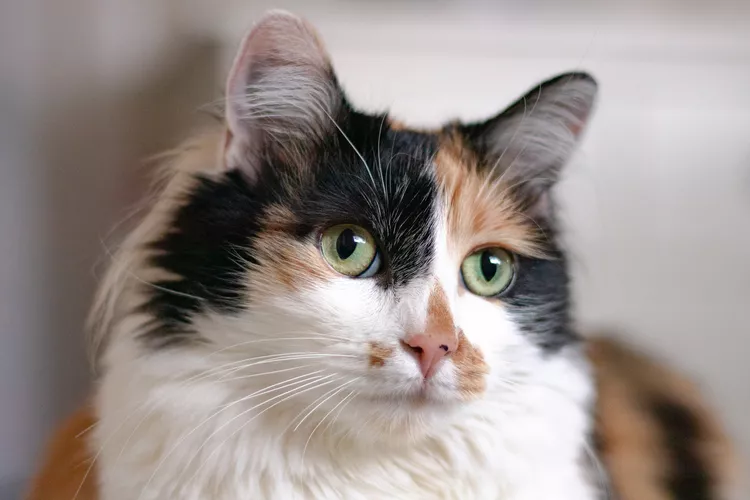
Although most people know that the vast majority of calico cats are female, they don’t always know that calico refers to a color pattern, not a breed of cat. Still, the genetics behind the calico coloration are fascinating and explain why male calico cats are so rare.
Let’s take a deeper look at what exactly is a calico cat, which breeds can have calico colors, and why there aren’t more male calico cats.
What Is a Calico Cat?
Calico cats are popular choices for cat lovers because of their gorgeous coats. But, unlike a Siamese or Persian cat, calico is not a feline breed. A calico can be a Persian, Maine coon, Manx, or several other breeds. For a cat to be labeled calico, their coat must contain three colors—black, white, and orange. These three colors appear on the coat in patches, often with white in the highest concentration. Calico cats are named for their coat color, which resembles calico cloth that was once imported to Europe from India.
Calico cats are often mistaken for tortoiseshell cats, and the terms can be used interchangeably in some regions. Tortoiseshells differ from calicos in that the colors are mixed or blended, with little to no white, while calicos have distinct patches with a large amount of white. Calicos can also have dilute coats, with fawn, cream, chocolate, and gray patches, rather than the traditional bright white, orange, and black.
What Breeds of Cats Can Be Calico?
Since we’ve established that calico is a color pattern, not a breed, does that mean any cat can be calico? Many breeds can produce calico cats, but not all. If your heart is set on owning one of these tricolored beauties, here are some of the more popular breeds that have calico coloring:
- Persian
- Maine coon
- Norwegian Forest Cat
- Turkish Angora
- Manx
- Exotic
- Selkirk Rex
- American bobtail
- American wirehair
- American curl
- American longhair
- American shorthair
- Japanese bobtail
- Cornish Rex
- Devon Rex
- Sphynx
Why Are So Many Calico Cats Female?
It's a fact that almost all calico cats are female because of the unique chromosomal makeup that determines the color variations in their coats.
The sex chromosomes (X and Y) determine whether a cat will be male or female. Each cat has a pair of sex chromosomes with the possible combinations of XX (female) and XY (male). The X chromosome also carries the coding gene for the black and orange colors in a calico cat's coat.
Female calico cats have two X chromosomes and therefore have two chromosomes with color code. Only if the cat gets one orange-coded X and one black-coded X, will she be calico, expressing both black and orange coloration.
For example, a cat receives an X chromosome from her mother that codes for black fur and an X chromosome from her father that codes for orange fur. While it only takes one X chromosome to make the fur a certain color, females are special with two X chromosomes. During development, one X chromosome can override the other, allowing either black or orange to be the dominant color in an area. This particular color development occurs in each individual cell, shutting down one X chromosome while allowing the other to be active. With varying dominant X chromosomes, a cat’s colors will also vary, which gives calico cats the orange and black colors.
But, where do the white patches come from? To make things even more complicated, calico cats must also inherit a gene unrelated to the X and Y chromosomes that codes for white fur.
Because male cats have one X chromosome with code for black or orange and one Y chromosome with no color genes, they cannot technically be calico. They'll only express either black or orange, but not both.
How Do Male Calico Cats Occur?
There are a couple of exceptions to the females-only calico rule: A genetic anomaly called Klinefelter’s Syndrome and chimerism. Klinefelter’s Syndrome occurs when a male inherits an extra X chromosome from either his father or mother, making his genetic makeup XXY. Chimerism occurs when a pair of embryos fuse very early in development, resulting in two different sets of DNA.
Both of these mutations are rare. These unicorn cats are almost always sterile, so they cannot be used to breed more calico patterns.
Unfortunately, since male calico cats are born because of a genetic anomaly, they are often much less healthy than their female counterparts. Male calicos can live long and healthy lives, but these special kitties require dedicated caretakers.
If you’re looking to welcome a calico kitty into your life, chances are she’ll be a female. But, you may get lucky and find a unicorn cat—a male calico. Whatever your feline friend’s color, you’re sure to enjoy your new cat’s company.